


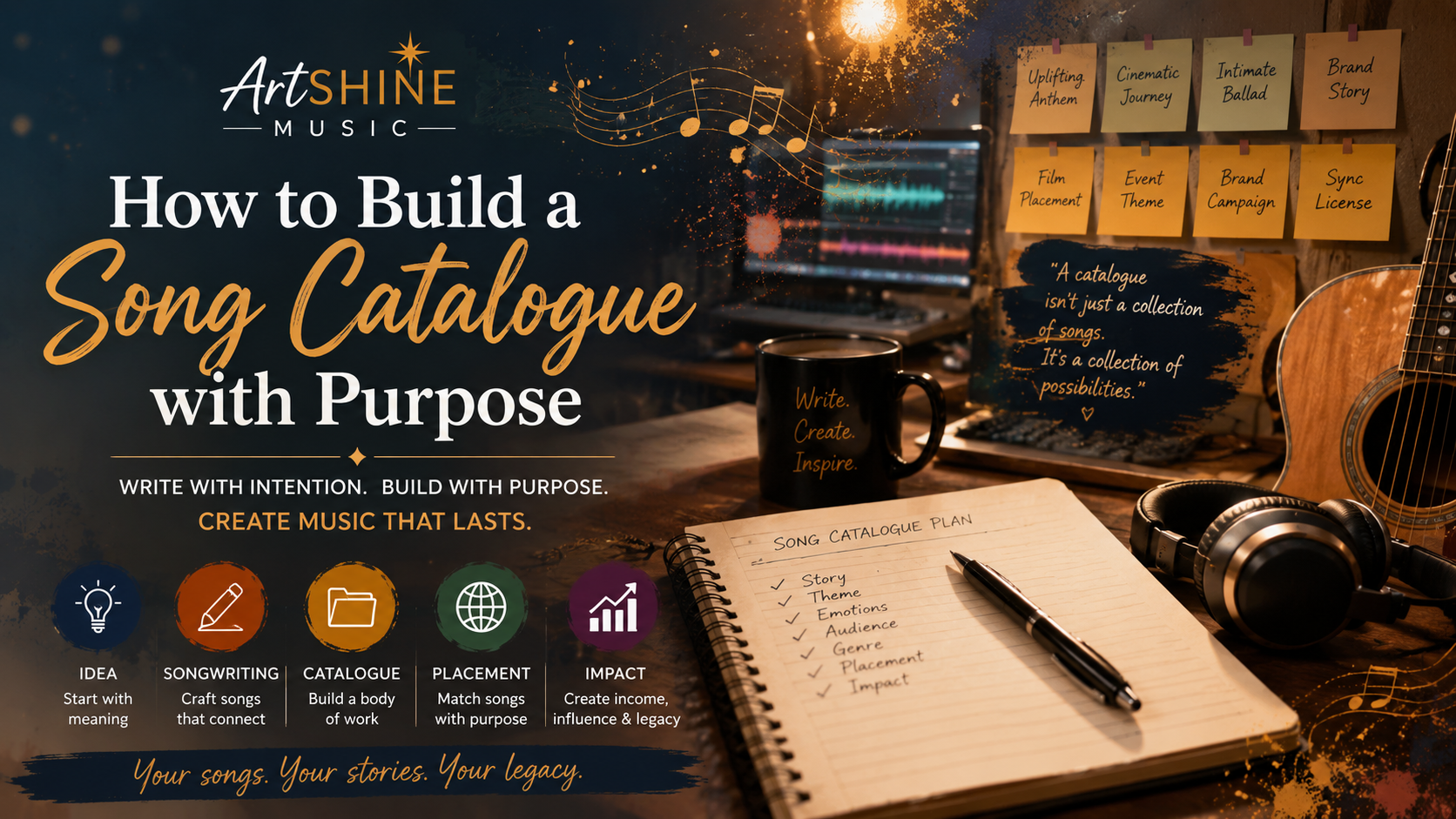
A song is more than a track.
It can be a story, a message, a memory, a mood, a brand voice, a film moment, an event theme, or a creative asset. When you start seeing songs this way, you begin to understand the value of building a song catalogue.
A song catalogue is a collection of songs, lyrics, jingles, instrumentals, demos, and music ideas that you own or control. It is not only a list of songs. It is a creative library that can grow over time and create future opportunities.
For songwriters, lyric writers, singers, musicians, and producers, a strong catalogue can support music licensing, collaboration, brand campaigns, film projects, events, podcasts, and creative partnerships.
At ArtSHINE Music, we believe a song catalogue should be built with story, purpose, and heart.
It should not be random.
It should have direction.
What Is a Song Catalogue?
A song catalogue is a collection of music works.
It may include:
songs
lyrics
melodies
jingles
theme songs
instrumentals
soundscapes
podcast intros
event songs
brand songs
children’s songs
film-friendly tracks
demo recordings
finished masters
Some songs may be fully recorded and ready to use. Others may still be lyrics, rough demos, or ideas waiting for the right singer, brand, filmmaker, or project.
The important thing is that your catalogue is organised and purposeful.
If someone asks, “Do you have a song for a film scene?” or “Do you have a jingle for a brand campaign?” you should know what you have and where to find it.
That is why building a catalogue matters.
Why a Song Catalogue Matters
Many music creators write one song, release it, and then move on.
That is fine, but a catalogue creates a longer-term pathway.
One song may open one door.
A catalogue can open many doors.
A strong song catalogue can help you:
pitch music for licensing
work with singers and bands
offer songs to filmmakers
create music for brands
build your identity as a songwriter
show your range
create future income opportunities
stay organised
develop your music career with purpose
A catalogue gives your songs a life beyond one release.
It helps you think like a creative entrepreneur, not only a hobby writer.
Start with Your Purpose
Before building a catalogue, ask:
Why am I creating this catalogue?
Your answer will shape the type of songs you create.
For example, your purpose may be:
to write songs for singers
to license songs for films
to create jingles for brands
to build a catalogue for podcasts and videos
to develop children’s songs
to create music for cultural events
to write songs for your own artist project
to support workshops, programs, or campaigns
to create emotional songs for documentaries
to build music assets for future licensing
When your purpose is clear, your catalogue becomes stronger.
You stop collecting random songs and start building a body of work with direction.
Know Who Your Catalogue Is For
A strong song catalogue should speak to a clear audience or market.
Ask:
Who might use my songs?
Singers?
Bands?
Film directors?
Brands?
Podcasters?
Event organisers?
Theatre makers?
Advertising agencies?
Children’s content creators?
Community organisations?
Creative businesses?
Each audience needs different types of music.
A singer may need lyrics that show vocal emotion.
A filmmaker may need songs that support a scene.
A brand may need a short, clear, memorable jingle.
A podcaster may need a polished intro or outro.
An event organiser may need a theme song or soundscape.
When you know who your catalogue is for, you can write with better focus.
Build Around Themes
One of the best ways to build a purposeful catalogue is to organise songs by theme.
For example:
hope
love
family
courage
identity
friendship
celebration
resilience
creativity
starting again
cultural memory
community
belonging
dreams
transformation
Themes help people find the right song for the right moment.
A filmmaker may ask for a song about grief and healing.
A brand may need a song about joy and confidence.
An event may need a song about unity and celebration.
A campaign may need a song about courage.
If your songs are organised by theme, you can respond quickly.
Build Around Usage
You can also organise your catalogue by how the music may be used.
For example:
film and television
podcasts
brand campaigns
commercial jingles
events
social media content
children’s stories
community campaigns
exhibitions
artist development programs
motivational videos
cultural festivals
This helps you think commercially.
A song for a film may need emotional space.
A song for a brand may need a strong hook.
A song for an event may need energy.
A song for a podcast may need a clear intro and outro structure.
When you build around usage, your catalogue becomes easier to license.
Create Different Versions of Each Song
A strong catalogue often includes more than one version of a song.
For example, one song may have:
full vocal version
instrumental version
acoustic version
short 60-second version
30-second version
15-second social media version
loopable background version
karaoke version
clean lyric version
demo version
This is useful for licensing.
A filmmaker may love the song but need an instrumental section for dialogue.
A brand may only need 15 seconds.
A podcaster may need a short intro.
An event organiser may need a longer version for walk-in music.
Different versions make one song more flexible.
This can increase its value.
Think About Mood and Energy
Music is often chosen by mood.
When someone searches for music, they may not only search by genre. They may search by feeling.
For example:
uplifting
warm
hopeful
sad
cinematic
fun
nostalgic
romantic
powerful
calm
dreamy
playful
emotional
inspiring
elegant
It is helpful to tag your songs by mood.
This makes it easier to match songs to projects.
A brand may say, “We need something warm and family-friendly.”
A filmmaker may say, “We need something emotional but not too sad.”
A podcast creator may say, “We need something inspiring and modern.”
If you know the mood of each song, you can recommend the right one quickly.
Do Not Only Write Full Songs
A song catalogue does not need to include only full-length songs.
It can include smaller music assets too.
For example:
short jingles
taglines with melody
chorus hooks
theme song ideas
instrumental loops
sound logos
podcast intros
children’s rhymes
event chants
campaign slogans
song starters
These smaller pieces can be very useful for commercial work.
A brand may not need a full three-minute song. It may need a 10-second jingle.
A podcast may not need a full composition. It may need a strong 20-second intro.
An event may need a simple theme that can be repeated.
Short music pieces can have strong licensing value.
Keep Your Lyrics Organised
If you are a lyric writer, your lyric catalogue is just as important as your song catalogue.
Some lyrics may not have music yet, but they may still be valuable.
Organise your lyrics by:
title
theme
mood
genre possibility
intended singer
usage idea
date written
ownership status
version number
You may have a lyric that does not suit you as a singer, but it may be perfect for someone else.
You may have a chorus that could become a brand jingle.
You may have a poem that could become a song for a film.
Do not lose your words.
They may become useful later.
Keep Clear Records
A good catalogue needs good records.
For each song, keep notes such as:
song title
writers
lyric writer
composer
producer
performer
recording date
version details
ownership shares
copyright information
PRO registration status
licensing status
whether it is exclusive or non-exclusive
where it has been used
links to audio files
links to lyric sheets
links to instrumental versions
This may sound boring, but it is important.
If someone wants to license your song, you need to know who owns what.
Clear records protect your work and make you look professional.
Understand Ownership Before Pitching
Before you offer a song for licensing, you need to know whether you have the right to license it.
Ask:
Did I write the lyrics?
Did someone else write the melody?
Who owns the master recording?
Did a producer contribute?
Did a singer perform on the recording?
Are there samples in the track?
Do I need permission from anyone else?
Is the song already licensed exclusively to someone?
If ownership is unclear, licensing can become difficult.
A purposeful catalogue is not only creative. It is also organised legally and commercially.
You do not need to know everything at once, but you should take rights seriously.
Create a Simple Catalogue Spreadsheet
You do not need complicated software to begin.
A simple spreadsheet can help.
You can include columns such as:
Song Title
Category
Theme
Mood
Genre
Length
Version
Lyrics Available
Instrumental Available
Writer
Performer
Ownership Notes
Possible Use
Status
Link to File
This gives you a clear overview of your music.
Over time, this spreadsheet becomes very valuable.
It helps you see what you have, what is missing, and what you can pitch.
Build Catalogue Gaps on Purpose
Once your catalogue is organised, you may notice gaps.
For example, you may have many emotional ballads but no upbeat jingles.
You may have songs about love but nothing for children’s content.
You may have full songs but no instrumental versions.
You may have strong lyrics but no demos.
These gaps are useful because they show you what to create next.
A purposeful catalogue grows strategically.
Instead of asking, “What should I write today?” you can ask:
“What does my catalogue need?”
This helps you build with direction.
Quality Matters More Than Quantity
It is better to have 20 strong, well-organised songs than 200 unfinished ideas you cannot find.
A large catalogue is useful only if the songs are clear, usable, and properly organised.
Quality matters.
Ask:
Is this song finished?
Is the lyric strong?
Is the recording good enough to pitch?
Does the song have a clear purpose?
Can I explain where it might be used?
Is ownership clear?
Do I have the right versions available?
A smaller catalogue with strong purpose can be more powerful than a large catalogue with no direction.
Build a Catalogue That Reflects Your Identity
Your catalogue should show who you are as a music creator.
For ArtSHINE Music, the identity is connected to story, purpose, and heart.
This means the catalogue should include songs that feel meaningful, useful, emotional, and connected to creative industries.
Your own catalogue may have a different identity.
It might be:
cinematic
pop-focused
cultural
children’s music
brand jingles
emotional ballads
motivational anthems
folk storytelling
dance tracks
podcast music
The important thing is consistency.
When people look at your catalogue, they should understand your creative voice.
Think Like a Licensing Partner
When building your catalogue, think about the person who may need your music.
A filmmaker may be under pressure to find the right song quickly.
A brand may need music that matches a campaign.
An event organiser may need a theme that feels professional.
A singer may need lyrics that suit their voice.
Make it easy for them.
Have clear titles.
Have short descriptions.
Have audio links ready.
Have lyrics ready.
Have instrumental versions where possible.
Have licensing notes prepared.
Know what each song is best suited for.
The easier you make the process, the more professional you appear.
Create Short Descriptions for Each Song
Each song in your catalogue should have a short description.
For example:
Shine Anyway
An uplifting anthem about courage, creative dreams, and choosing to keep going even when life is difficult. Suitable for motivational videos, creative events, artist programs, and brand campaigns about resilience.
This type of description helps people understand the song quickly.
You can include:
mood
theme
possible use
audience
emotional tone
This is very helpful for licensing and pitching.
Refresh Your Catalogue Regularly
A catalogue is not something you organise once and forget.
Review it regularly.
You may need to:
update file links
add new versions
remove weak demos
finish old lyrics
register songs properly
create instrumental versions
add descriptions
change categories
note where songs have been used
prepare songs for pitching
A quarterly review is a good habit.
Your catalogue should grow with you.
ArtSHINE Music’s Approach to Catalogue Building
At ArtSHINE Music, we see a song catalogue as a creative library.
It is not only about having many songs.
It is about building music that can serve stories, people, brands, films, events, podcasts, and creative campaigns.
A purposeful catalogue may include:
songs for creatives
songs for cultural stories
songs for family and memory
songs for events
songs for brands
songs for films
jingles
soundscapes
podcast themes
motivational anthems
Each song should have a reason to exist.
Each song should be easy to understand, organise, and present.
That is how music becomes more than a track.
It becomes an opportunity.
Final Thoughts
Building a song catalogue with purpose is one of the most important steps for any songwriter, lyric writer, musician, or producer who wants to take their music seriously.
A catalogue helps you organise your work.
It helps you see your music as a creative asset.
It helps you prepare for licensing, collaboration, and commercial opportunities.
Start simple.
List your songs.
Organise your lyrics.
Add themes and moods.
Create different versions.
Keep clear records.
Think about who your songs are for.
Build the gaps with purpose.
Your catalogue does not need to be perfect from day one.
It simply needs to begin.
Because one song can open a door.
But a strong catalogue can build a pathway.
Call to Action
Are you a singer, songwriter, lyric writer, musician, filmmaker, brand, or creative business looking for original songs, lyrics, jingles, or music concepts?
ArtSHINE Music creates and develops music with story, purpose, and heart for films, brands, events, podcasts, campaigns, and licensing opportunities.
Let your songs become more than tracks.
Let them become creative assets that can travel, connect, and shine.