


There are instruments that immediately tell you where a piece of music has come from.
And then there are instruments that seem to carry you somewhere before you even know their name.
The guzheng can do both.
A single plucked note can feel delicate and intimate. A sweep across its strings can sound like water rushing over stones. Rapid passages can create excitement and momentum, while a slowly bending note can carry an extraordinary sense of longing.
For ArtSHINE Music, this is what makes the guzheng so fascinating.
It is unmistakably connected to Chinese musical culture, yet its expressive possibilities extend far beyond recreating the sounds of the past.
Placed thoughtfully within contemporary music, the guzheng can become a bridge between tradition and a new musical story.
What Is the Guzheng?
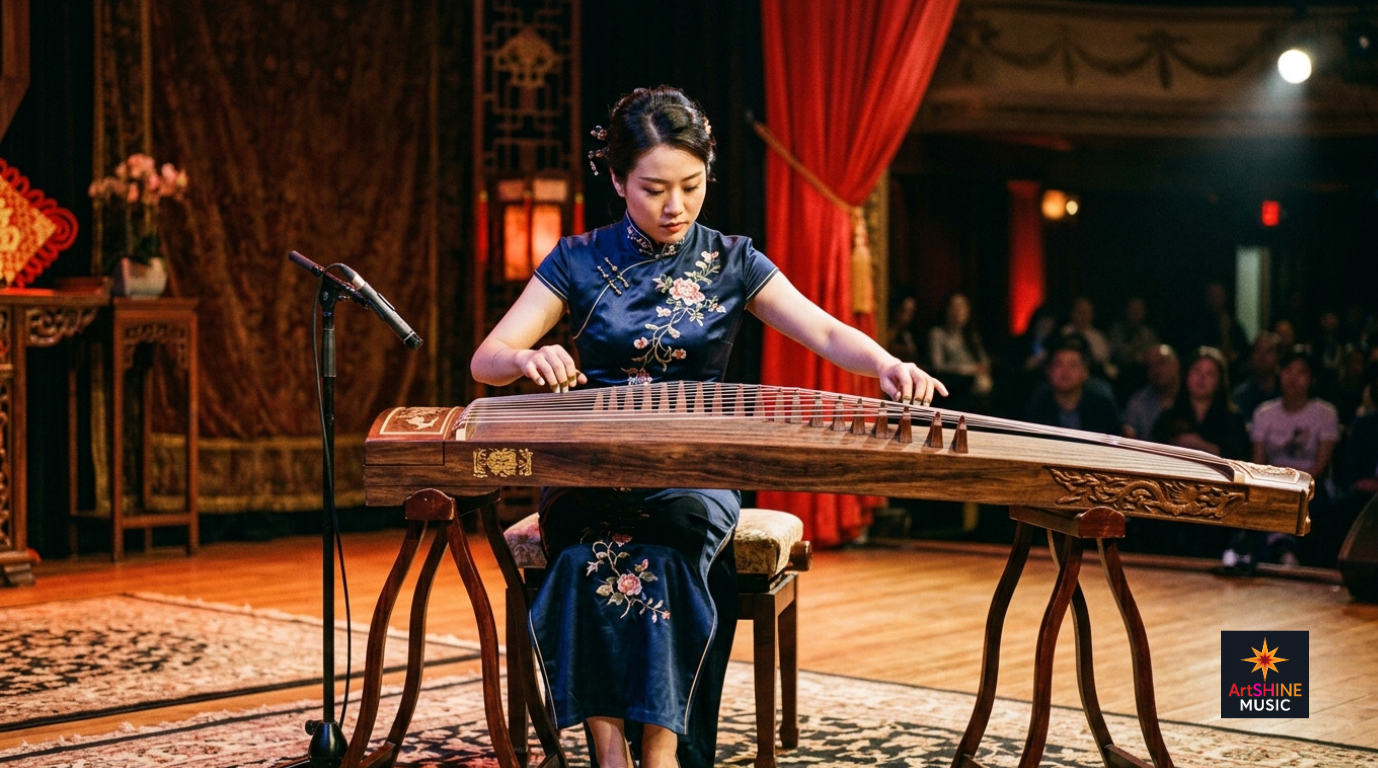
The guzheng is a traditional Chinese plucked string instrument belonging to the zither family.
Its history stretches back more than two thousand years, with early forms associated with ancient China during the Qin period. Like many instruments with such a long history, the guzheng has continued to evolve in its construction, playing techniques and repertoire.
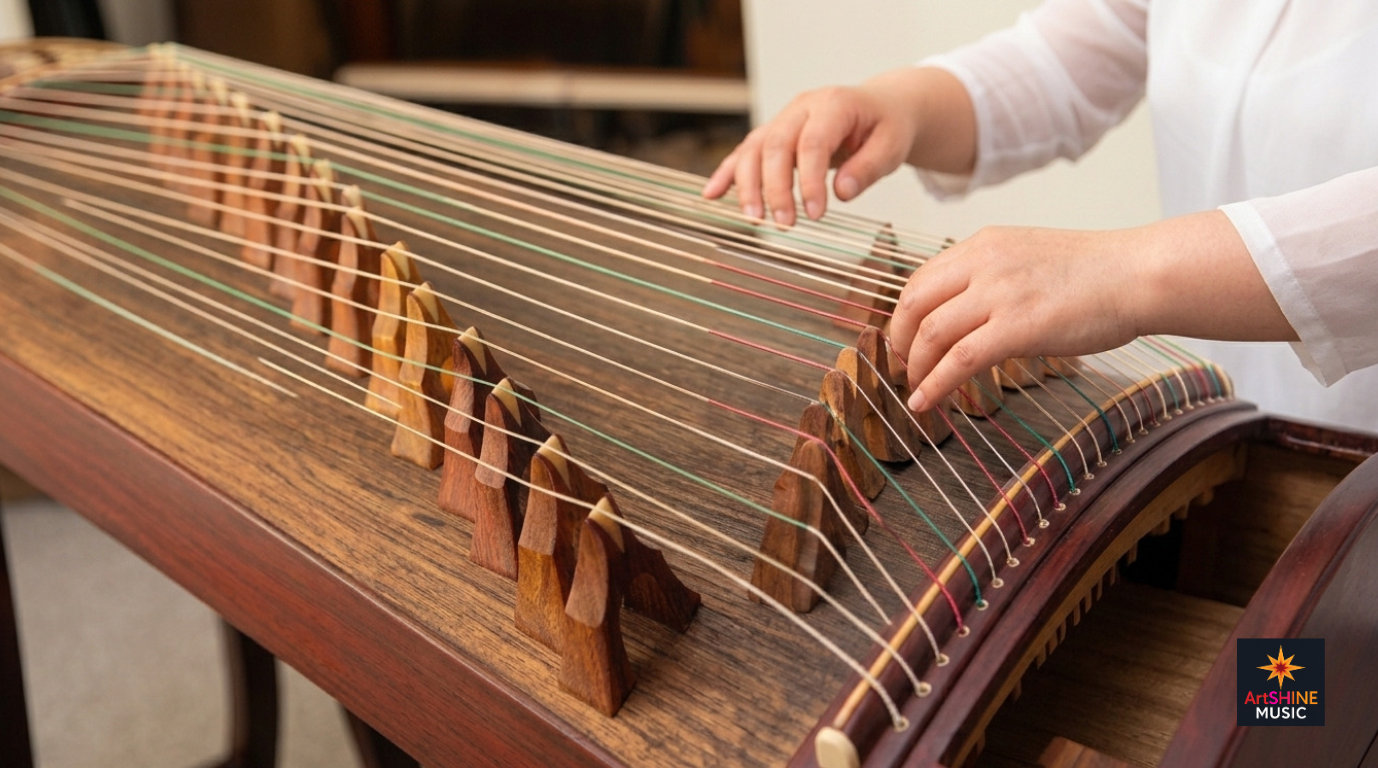
Modern guzhengs commonly have 21 strings stretched across a long wooden soundboard, with movable bridges positioned beneath the strings.
The musician traditionally wears picks on the fingers of the right hand to pluck the strings.
But the left hand is equally important.
By pressing, bending and manipulating the strings on the other side of the bridges, the performer can alter pitch, create vibrato and produce expressive ornaments.
That interaction between plucking and shaping the note is central to the instrument's distinctive voice.
A Sound That Can Move Like Water
One of the beautiful qualities of the guzheng is its ability to create movement.
Its strings can shimmer.
They can ripple.
They can cascade.
A performer can sweep rapidly across several strings, creating a flowing effect that can evoke water, wind or movement through a landscape.
But the instrument is equally capable of stillness.
A single note can be allowed to resonate while the performer gently bends its pitch. That tiny movement can completely change the emotional character of the sound.
This gives composers an enormous emotional palette.
The guzheng can feel peaceful.
Reflective.
Joyful.
Dramatic.
Mysterious.
Romantic.
Nostalgic.
Or powerful.
That is why simply describing it as a "traditional Chinese sound" doesn't do the instrument justice.
It is a musical voice capable of telling many different kinds of stories.
An Instrument Shaped by Generations
The guzheng's long history also means that there is no single way of playing it.
Different regional schools and traditions developed their own approaches to technique, ornamentation, repertoire and musical expression.
This is an important reminder whenever we work with cultural instruments.
A guzheng is not simply a sound that can be selected because a composition needs to feel "Chinese."
Behind the instrument are generations of musicians, teachers, composers and regional traditions.
Understanding that history changes the way we listen.
At ArtSHINE Music, we believe this distinction matters.
When cultural instruments are used only as shorthand for a place or ethnicity, their musical possibilities become smaller.
When we understand them as expressive instruments in their own right, the possibilities become much greater.
The Guzheng in Contemporary Music
An instrument with an ancient history does not need to remain in an ancient setting.
The guzheng can work beautifully within contemporary composition.
It can sit beside piano.
It can interact with orchestral strings.
It can float above atmospheric electronic textures.
It can respond to percussion.
It can become part of cinematic music.
It can even appear within contemporary pop arrangements.
The important question is not whether these combinations are traditional.
The question is whether they are musically meaningful.
A guzheng does not have to disappear into a Western arrangement to belong there.
Its distinctive attack, resonance and pitch bending can provide something that a piano, harp or guitar cannot reproduce in quite the same way.
The goal should be to preserve that character.
Guzheng and Piano: Two Different Ways of Touching a String
The guzheng and piano provide an interesting musical relationship.
Both ultimately create sound through vibrating strings, but the way the musician interacts with those strings is completely different.
On the piano, keys activate hammers that strike the strings inside the instrument.
On the guzheng, the musician has direct physical contact with the strings.
They pluck them.
Press them.
Bend them.
Shape their resonance.
Put the two instruments together and that contrast becomes part of the music.
The piano can provide harmony, structure and depth while the guzheng moves around it with bends, ornamentation and flowing phrases.
Neither needs to imitate the other.
They can occupy different musical spaces while contributing to the same story.
Guzheng and Western Strings
Another beautiful possibility is pairing the guzheng with violin, viola or cello.
Here we begin to hear a conversation between plucked and bowed strings.
The guzheng produces a note with a defined beginning: the string is plucked and then allowed to resonate.
A bowed string instrument can sustain and shape a note over a much longer period.
That contrast can be incredibly expressive.
Imagine a guzheng phrase appearing like droplets of sound while a cello holds a warm note underneath.
Or rapid guzheng passages moving around an expanding orchestral string arrangement.
One instrument creates movement.
The other creates space.
Together they can create emotional depth that neither needs to carry alone.
The Guzheng Doesn't Always Need to Sound Ancient
This is particularly important to the way we think about music at ArtSHINE.
If a story involves Chinese culture, the music does not automatically need to sound historical.
Chinese stories are also contemporary stories.
They happen in modern cities.
They involve migration, families, relationships, businesses, celebrations and communities living around the world.
A guzheng can therefore appear alongside contemporary production without losing its cultural identity.
Imagine it within music for a modern Sydney story.
A destination campaign.
A contemporary Chinese Australian film.
A fashion collection.
A cultural festival.
A brand launching into an Asian market.
A story about memory and migration.
Or a cinematic soundtrack.
The instrument brings its history with it, but the story being told can belong completely to today.
Story Comes First
This brings us back to one of the principles behind our Instrument Stories series.
At ArtSHINE Music, we don't want to begin with:
"Let's put a guzheng in this song."
We want to begin with:
"What story are we trying to tell?"
Perhaps the story needs intimacy.
Perhaps it needs movement.
Perhaps it needs a connection with Chinese culture.
Perhaps it needs a feeling of memory or distance.
Perhaps the composition needs an expressive musical voice that contrasts beautifully with a Western orchestra.
Only then do we ask whether the guzheng belongs in that musical world.
Because an instrument should never be there simply to announce a culture.
It should contribute to the story.
Listening to the Music Between Cultures
This is where the guzheng becomes especially exciting for ArtSHINE Music.
We are interested not only in what an instrument can do alone, but what can happen when it begins a conversation with another musical tradition.
What happens when guzheng meets harp?
What happens when it meets piano?
Cello?
Orchestra?
Contemporary percussion?
Electronic sound?
There isn't one correct answer.
Every combination creates a different emotional landscape.
And that is exactly what Instrument Stories — Where Musical Worlds Meet is designed to explore.
We are not searching for a generic fusion sound.
We are listening for relationships.
For contrast.
For harmony.
For moments when two instruments remain unmistakably themselves but somehow create a third musical possibility together.
The guzheng is a wonderful place to begin that journey.
More than two thousand years of musical history live within its strings.
But those strings are still capable of telling stories that haven't been written yet.
Bring a Distinctive Musical Voice to Your Story
Are you creating a film, brand campaign, cultural celebration, destination experience, event or special project?
ArtSHINE Music creates original music that brings cultural instruments, contemporary composition and storytelling together.
You can license an existing ArtSHINE Music song, or talk to us about customising or creating original music for your brand, organisation, film, event or project.
Talk to ArtSHINE Music and discover what your story could sound like.
Next in Instrument Stories: The Violin — Four Strings, Endless Emotion.